July 15, 2026
Apple HomePod Review 2026: Specs, Price and Is It Worth $349?
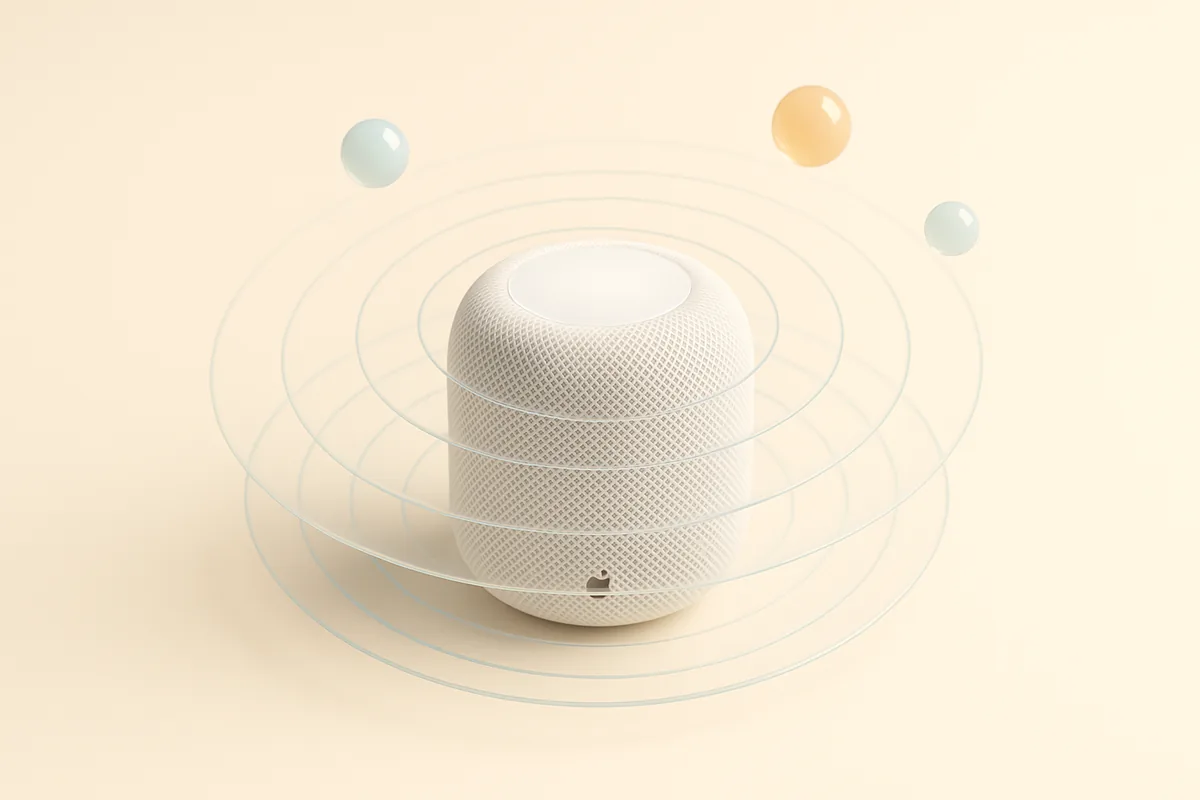
Apple HomePod (2nd Gen) Full Specifications
| Specification | HomePod (2nd generation) |
|---|---|
| Announced / released | 18 January 2023 / 3 February 2023 |
| Dimensions | 5.6 in wide (142 mm) × 6.6 in high (168 mm) |
| Weight | 5.16 lb (2.3 kg) |
| Woofer | 4-inch high-excursion, 20 mm diaphragm travel |
| Tweeters | Five, horn-loaded, beamforming array (1st gen had seven) |
| Microphones | Four far-field + one internal calibration mic |
| Chip | S7 — from Apple Watch Series 7 (2021) |
| Spatial Audio | Dolby Atmos (video requires Apple TV 4K) |
| Room sensing | Yes — detects wall vs freestanding, adapts in real time |
| Wi-Fi | 802.11n (Wi-Fi 4) — a downgrade from the 1st gen's Wi-Fi 5 |
| Bluetooth | 5.0 — setup and proximity only, no Bluetooth audio |
| Thread / Matter | Yes — full Thread border router, home hub |
| Ultra Wideband | U1 chip (Handoff proximity) |
| Sensors | Temperature, humidity, accelerometer |
| Voice recognition | Up to six voices |
| Colours | White, Midnight |
| Apple's price (July 2026) | $349 (was $299) |
How Does the HomePod Actually Sound?
Professional opinion is broadly positive but not unanimous:| Publication | Score | Verdict |
|---|---|---|
| What Hi-Fi? | 5/5 (Awards 2025 winner) | "An irresistible choice if you're an Apple user" |
| Engadget | 84/100 | "Stellar sound quality… can over emphasize vocals" |
| CNET | 8/10 | "Sounds great, but its high price and Apple-centric features exclude too many" |
| TechRadar | 4/5 | "Rich sound, but doesn't fix the original's problems" |
| Tom's Guide | 4/5 | "Much more expensive than our favorite smart speaker" |
| The Verge | 7/10 | "Better all around… but Apple played it too safe" |
| DXOMARK | 113 (ranked 39th) | "Very weak midrange… dynamic performance was poor" |
| Wirecutter | Top pick | "Best smart speaker for music" — but "costs a lot for the performance" |
The measured data
This is where marketing meets a microphone. These are the only hard numbers worth citing:| Measurement | HomePod 2 | Echo Studio | Sonos One SL |
|---|---|---|---|
| Max volume | 87.2 dB | 94.1 dB | 89.6 dB |
| Max bass output (CTA-2010, 40–63 Hz) | 71.5 dB | 82.0 dB | 74.1 dB |
An honest disagreement worth knowing about
Reviewers who A/B tested the 2nd gen against the original flatly contradict each other, and you should know that before trusting any single verdict. TechRadar, the only outlet to publish its method, found it quieter: "the new version is not as loud as the original. I tested it directly against the original model, and the HomePod 2 at about 50% of maximum volume was equivalent to the original being at roughly 33%." CNET found the opposite: "The HomePod 2 sounded better than the original with a more intimate vocal response… also a little louder." DXOMARK's lab measurements agree with CNET. One popular theory is not supported: no reviewer blamed the reduction from seven tweeters to five for any regression. Engadget explicitly noted the speaker "doesn't suffer any performance setbacks" from the reduced component count.The Weaknesses Apple Doesn't Advertise
- Siri has great ears and a poor brain. Every outlet praises the far-field microphones and criticises the intelligence. The Verge: "'Sorry, that was taking too long' is a response you're guaranteed to hear more than once." TechRadar is harsher: Siri "should be thought of as a simple voice remote control for your speaker rather than a smart voice interface."
- No Bluetooth audio, and no line-in — ever. Neither HomePod generation has ever had an aux input. AirPlay 2 only. A guest with an Android phone cannot play music on it at all.
- A single HomePod downmixes stereo to mono. One unit is functionally a mono speaker. The experience reviewers actually recommend is a stereo pair — which at Apple's price is now $698.
- No EQ or sound customisation. It ignores the EQ you set for Apple Music on your iPhone. Sonos gives you bass and treble controls.
- Multi-user works on paper. Six voices are supported, but The Verge found it "a mess" — repeatedly asking "Who is this?" for already-configured users.
- Siri can't set Spotify as default. You can AirPlay Spotify; you cannot voice-request it.
- Wi-Fi 4 in 2026. 802.11n — genuinely a downgrade from the 1st generation.
- It stains wood furniture. Tom's Guide published a correction confirming the 2nd gen stains wood like the original. Use a coaster.
- The sound signature isn't neutral. Wirecutter measured a bass lift around 100 Hz plus a treble boost — exciting on modern pop, but it "can sound unnatural for genres such as folk, jazz, and older rock." Wirecutter preferred the Echo Studio's balance.
HomePod vs HomePod mini: The $220 Question
There is no 2nd-generation HomePod mini. The mini on sale today is the October 2020 original — nearly six years old, on a 2019 S5 chip — and it just rose 30.3% to $129, the largest percentage increase of any Apple product in June.| HomePod (2nd gen) | HomePod mini | |
|---|---|---|
| Apple's price | $349 | $129 |
| Drivers | 4" woofer + 5 tweeters | 1 full-range + 2 passive radiators |
| Chip | S7 (2021) | S5 (2019) |
| Room sensing | Yes | No |
| Spatial Audio / Atmos | Yes | No |
| Thread / Matter hub | Yes | Yes — identical |
| Temperature / humidity sensor | Yes | Yes — identical |
| Colours | 2 | 5 |
HomePod vs Sonos and Echo in 2026
| Speaker | Price today | Notes |
|---|---|---|
| Apple HomePod (2nd gen) | $349 (was $299) | Price rose June 2026 |
| Sonos Era 100 | $219 (launched $249) | Price cut — Bluetooth, line-in, EQ |
| Sonos Era 100 SL | $189 | New, March 2026 |
| Amazon Echo Studio (2nd gen) | $219.99 | Louder, far more bass output |
| Sonos Era 300 | $479 | Beats HomePod on spatial audio |
| Apple HomePod mini | $129 (was $99) | Six-year-old hardware |
The Siri AI Problem: The Strongest Reason to Hesitate
This is the most important thing in this guide, and most reviews have not caught up with it. Apple announced Siri AI at WWDC on 8 June 2026 — a genuinely rebuilt assistant with multi-turn conversation, real-time world knowledge and chained multi-step tasks, shipping with iOS 27 in September 2026. It fixes precisely the complaint every HomePod reviewer has made for three years. The current HomePod almost certainly will not get it. Siri AI needs a fast processor and substantial RAM. The HomePod runs a 2021 S7; the mini runs a 2019 S5. Apple Intelligence requires roughly 8GB of RAM on other devices — a HomePod mini is estimated to have around one-eighth of that. Supporting evidence: tvOS 27 beta code contains Apple Intelligence frameworks and HomePod setup references to Siri AI, but AppleInsider reads that as evidence for new hardware, since the same code references an N1 chip that exists in no shipping HomePod. Apple TV and HomePod were absent from the WWDC keynote entirely. To be fair and precise: Apple has not said this, and nobody has asked directly. It is a strong inference from the silicon, not a confirmed fact. The current HomePod does keep receiving software updates — HomePod Software 27 adds AutoMix for Apple Music. Meanwhile, Bloomberg's Mark Gurman confirmed in March 2026 that a new full-size HomePod is coming, and MacRumors' Buyer's Guide rates the HomePod "Caution" and the mini "Don't Buy." No specifications for the successor have leaked.Is the Apple HomePod Worth It in 2026?
At Apple's $349, for most people: no. You would be paying 16.7% more for 3.5-year-old hardware, on a 2021 chip with Wi-Fi 4, weeks before a successor is expected, and buying into the old Siri exactly as Apple replaces it everywhere else. The mini does every smart-home trick for $129, and the Sonos Era 100 costs $130 less. It is worth it for a specific buyer: someone deep in the Apple ecosystem who wants the best-sounding smart speaker for Apple Music today, ideally as a stereo pair, and who treats Siri as a voice remote rather than an assistant. That buyer is exactly who What Hi-Fi (5/5), Wirecutter ("best smart speaker for music") and TechRadar all still endorse. TechRadar's conditional is precise: "if you're the target market – music lovers who go big on Apple devices – nothing else sounds as good for the same price, especially if you step up to a pair of them."What changes the maths: the price you pay
Most of the case against the HomePod is really a case against $349. At a lower price, the calculus shifts — the sound quality does not change, and the $130 Sonos gap narrows sharply.| Product | Apple's price | AppleCryptos price | You save |
|---|---|---|---|
| HomePod (2nd gen), White | $349 | $259 | $90 |
| HomePod (2nd gen), Midnight | $349 | $259 | $90 |
| HomePod mini | $129 | $89 | $40 |
| Apple TV 4K | $199 | $119 | $80 |
Frequently asked questions
How much does the Apple HomePod cost in 2026? Apple sells the HomePod (2nd generation) for $349, raised from $299 on 25 June 2026 — a 16.7% increase. The HomePod mini rose from $99 to $129. AppleCryptos currently sells the HomePod at $259 and the mini at $89.
Is the Apple HomePod worth buying in 2026? At Apple's $349 it is hard to recommend for most people: the hardware dates to January 2023, a successor is expected this year, and it will almost certainly not receive Siri AI. It remains the best-sounding smart speaker for committed Apple Music users, especially as a stereo pair, and What Hi-Fi still rates it 5/5.
Will the HomePod get Siri AI? Almost certainly not. Siri AI requires significant processing power and RAM; the HomePod uses a 2021 S7 chip and the mini a 2019 S5. Apple has not confirmed this either way, but HomePod is never mentioned in Apple Intelligence materials, and Apple TV and HomePod were absent from the WWDC 2026 keynote.
Is a new HomePod coming in 2026? Yes. Bloomberg's Mark Gurman confirmed in March 2026 that a new full-size HomePod is planned, alongside a new HomePod mini and Apple TV, all reportedly held up by the Siri overhaul. No specifications have leaked. MacRumors rates the current HomePod "Caution."
HomePod or HomePod mini — which should I buy? The mini has identical smart-home capability: same Thread and Matter hub, same temperature and humidity sensor, same Sound Recognition. You pay the difference purely for sound quality. If you want a smart-home hub or casual listening, the mini is the smarter buy; if you want genuine music performance, the full-size HomePod is materially better.
Does the HomePod have Bluetooth audio or an aux input? No. It has Bluetooth 5.0 for setup and proximity only, and neither HomePod generation has ever had a line-in. Audio comes via AirPlay 2, which means an Android guest cannot play music on it.
HomePod vs Sonos Era 100 — which is better? On pure sound with Apple Music, reviewers including What Hi-Fi favour the HomePod. The Era 100 costs $219 to Apple's $349, and adds Bluetooth, line-in and EQ controls, plus AirPlay 2 support so Apple users can still use it. The Era 100 lacks a built-in Matter and Thread hub.
Do I need two HomePods? A single HomePod downmixes stereo content to mono, so a stereo pair is the experience reviewers recommend. At Apple's price that is $698; at our $259 each it is $518. Both units must be the same model — you cannot pair a 2nd gen with a 1st gen or a mini.
By Alex Carter, Apple & Crypto Analyst at AppleCryptosReady to buy Apple with crypto?
Shop genuine, sealed Apple products and pay privately with Bitcoin, USDT and 20+ coins.
Browse products