March 20, 2026
Apple HomePod Mini Speaker Full Review: Complete 2026 Guide
By Alex Carter, Apple & Crypto Analyst at AppleCryptos · Last updated March 20, 2026
Apple HomePod Mini in 2026: The Smart Speaker That Keeps Getting Better
The Apple HomePod Mini is one of the most deceptively capable devices in Apple’s entire product lineup. Launched in 2020 at $99, it has steadily grown more useful with every software update, every HomeKit expansion, and every new iPhone and Apple Watch that joins the ecosystem it serves. In March 2026, it remains not just relevant but genuinely compelling — a rare feat for smart home hardware that typically ages quickly.
What makes this review different from those written at launch is the accumulated software maturity. The HomePod Mini of 2026 is running on a fundamentally more capable software stack than the device that shipped in 2020. Siri has improved substantially. HomeKit automation depth has expanded. AirPlay 2 multi-room performance has been refined. Matter compatibility has opened thousands of new device integrations. The hardware is unchanged, but what that hardware enables has grown considerably.
For Apple device owners — and especially for those exploring how cryptocurrency fits into the Apple ecosystem — the HomePod Mini deserves fresh evaluation in 2026. This comprehensive Apple HomePod Mini review covers everything that matters: audio performance, Siri intelligence, HomeKit hub capability, privacy architecture, AirPlay multi-room features, competitor comparisons, and how the device intersects with Apple’s expanding financial and crypto-adjacent features.
Design, Hardware, and What Is Inside the HomePod Mini
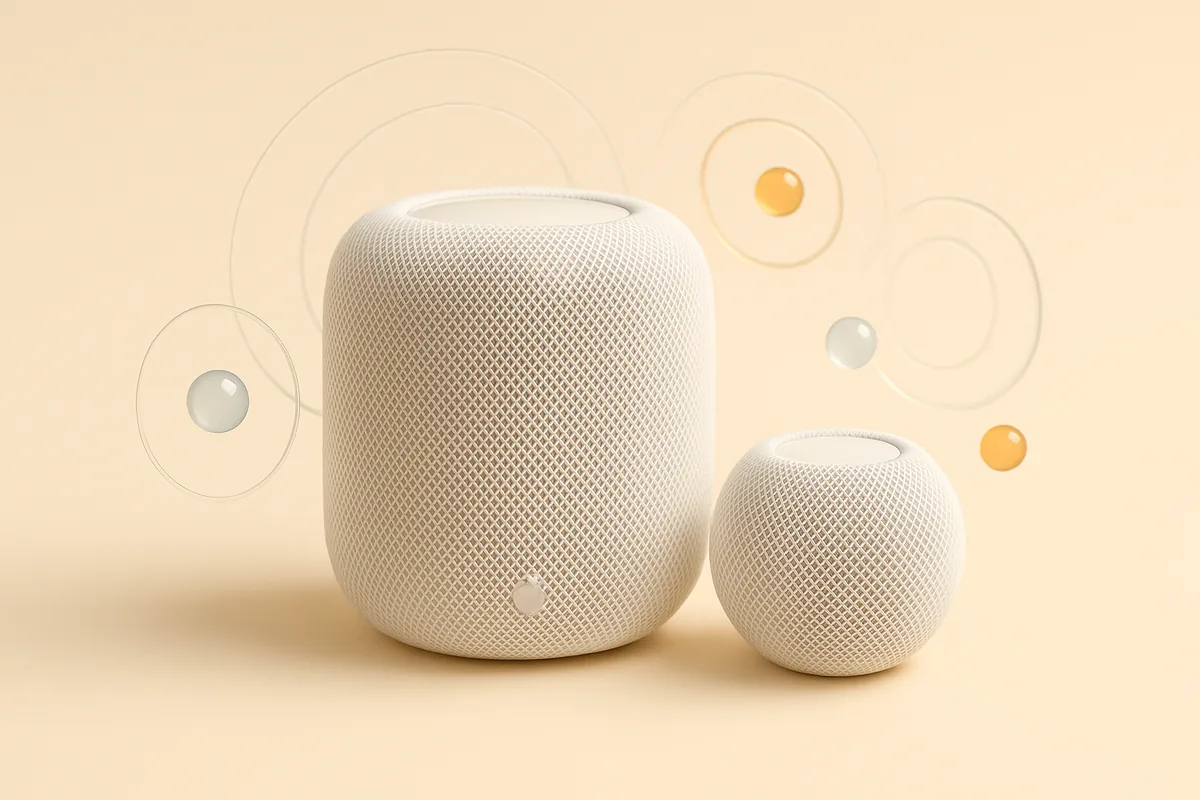
The HomePod Mini’s industrial design remains one of the most thoughtful in the smart speaker category. The spherical mesh fabric housing — available in Midnight, White, Yellow, Orange, and Blue — sits on a flat base with a backlit touch-sensitive top surface for volume, playback control, and Siri invocation. At 3.3 inches tall and weighing 345 grams, it is genuinely compact enough to fit anywhere without demanding visual attention, yet substantial enough to feel like purposeful hardware rather than a throwaway gadget.
The hardware foundation is Apple’s S7 chip — the same processor used in the Apple Watch Series 7. It handles the computational audio processing, Siri inference, HomeKit hub operations, and AirPlay 2 networking simultaneously and efficiently. The S7’s neural engine runs the local voice recognition model that detects “Hey Siri” without sending audio to Apple’s servers until the wake word is confirmed — a privacy-first architectural decision that distinguishes HomePod Mini from several competing smart speakers.
Internally, the speaker system consists of a full-range driver with a custom-designed waveguide and a passive radiator for bass extension. The microphone array includes five beam-forming microphones arranged to detect voice commands clearly even during music playback — a practical engineering challenge that Apple has solved more effectively than most competitors at this price point. The device connects via Wi-Fi 802.11n (2.4GHz and 5GHz) and includes an Ultra Wideband chip for the spatial awareness features used in Handoff and proximity detection with iPhone.
One significant hardware omission that distinguishes the HomePod Mini from the full-size HomePod 2nd Gen is the absence of a temperature and humidity sensor. The second-generation full-size HomePod added these environmental sensors in 2023, enabling native home automation triggers based on ambient conditions. The HomePod Mini does not include them — an absence that matters for buyers who want environmental sensing in their smart home setup and would need to add a separate sensor accessory to achieve it through HomeKit.
How Does the HomePod Mini Sound? Audio Performance Deep Dive
Audio performance is where the Apple HomePod Mini most consistently surprises people hearing it for the first time. The computational audio processing engine does genuinely remarkable work with the physical constraints of a 3.3-inch spherical enclosure, producing a sound that is richer, more spatially convincing, and more tonally balanced than the device’s size would suggest is possible.
The 360-degree audio dispersion — achieved through the custom waveguide directing sound outward and upward in all directions simultaneously — means the HomePod Mini sounds similar regardless of where you are standing relative to the speaker. Unlike directional speakers that have an obvious sweet spot, the HomePod Mini is designed to fill a room from any listening position. For kitchen countertop placement, bedroom use, or office desk positioning — the three most common HomePod Mini deployment scenarios — this non-directional quality is a meaningful practical advantage.
Midrange frequency reproduction is the standout strength. Vocal clarity across podcasts, audiobooks, radio, and music is excellent — clean, detailed, and natural-sounding without the harshness that plagues cheaper speaker drivers in the same price class. Treble extension is controlled and non-fatiguing; Apple’s audio tuning errs toward warmth rather than brightness, which makes extended listening sessions comfortable. These qualities make the HomePod Mini particularly good at spoken word content — arguably the primary use case for most smart speakers regardless of what buyers tell themselves at purchase time.
Bass performance is honest rather than impressive. The passive radiator extends low-frequency response meaningfully for the device’s size — you get a sense of bass presence that is absent from competing speakers at $49 to $79 — but physics imposes real limits. Sub-bass below 60Hz is not reproducible at meaningful levels from a 3.3-inch enclosure, which means bass-heavy music genres reveal the device’s physical limitations. For comparison, a stereo pair of HomePod Minis — supported natively and configured easily through the Home app — substantially improves bass extension, stereo imaging, and overall loudness, making it the recommended configuration for anyone who cares significantly about music listening quality rather than just voice assistant access.
How Intelligent Is Siri on HomePod Mini in 2026?
Siri’s capabilities on the HomePod Mini have improved meaningfully through multiple software generations, and the 2026 experience is substantially more capable than what shipped with the device at launch. The improvements span natural language processing accuracy, multi-step request handling, personalized voice recognition, and deeper integration with Apple’s expanding suite of first-party apps and services.
Personal Voice Recognition — the system’s ability to distinguish between multiple household members and deliver personalized responses — now works reliably across the most common use cases. When a family member asks about their calendar, they get their own events, not a household-wide list. When they request music, they get recommendations based on their own Apple Music listening history. Reminders, messages, and phone calls all route correctly to the requesting user’s account rather than defaulting to the primary Apple ID holder. This multi-user capability transforms the HomePod Mini from a single-user device into a genuinely household-compatible assistant.
Multi-step and conditional natural language requests have improved substantially. Asking Siri to “remind me to call the dentist when I get home” or “turn off all the lights in 20 minutes and set the thermostat to 68 degrees” executes correctly and reliably in 2026 where earlier versions required more precise command phrasing to interpret intent correctly. The underlying language model improvements powering these capabilities reflect Apple’s accelerated AI investment, with on-device inference handling an expanding share of query processing for speed and privacy.
The areas where Siri continues to trail competing assistants are worth acknowledging honestly. Amazon Alexa maintains a substantially larger ecosystem of third-party skills — voice-enabled integrations with external services — than Siri’s equivalent capability set. Google Assistant continues to outperform Siri on open-ended general knowledge queries, leveraging Google’s search infrastructure for factual question answering. For users who primarily use their smart speaker for Apple ecosystem management — controlling HomeKit devices, playing Apple Music, managing calendar and reminders, making calls — these gaps are largely invisible. For users who want a comprehensive general-purpose AI assistant, they are real limitations to acknowledge.
HomeKit Hub Performance: Automating Your Smart Home
The HomePod Mini‘s function as a HomeKit hub is one of its most practically significant capabilities and one that adds substantial value beyond its role as a speaker or Siri interface. Any HomePod Mini connected to your home network automatically serves as a persistent HomeKit hub, enabling remote access to connected accessories, reliable automation execution even when your iPhone is away from home, and end-to-end encrypted communication throughout your smart home infrastructure.
HomeKit’s device compatibility in 2026 is dramatically broader than it was at the HomePod Mini’s launch, primarily due to the Matter protocol’s emergence as a cross-manufacturer standard. Matter — developed collaboratively by Apple, Amazon, Google, Samsung, and the Connectivity Standards Alliance — defines a common communication layer that allows devices from different manufacturers to work across all major smart home ecosystems. A Matter-certified smart bulb, door lock, thermostat, or sensor configured once will work natively with the HomePod Mini through Apple’s Home app without any additional configuration steps or third-party bridges.
Automation capabilities through HomePod Mini as hub cover all the scenarios that make a smart home genuinely useful rather than just technically impressive. Presence-based automations — turning lights on when the first household member arrives home and off when the last one leaves — execute reliably using iPhone location services through the HomePod hub. Time-based automations for morning routines, evening wind-down sequences, and overnight security settings run on the HomePod Mini’s own clock without depending on an iPhone being present. Sensor-triggered automations — motion-activated lights, door-open alerts, temperature threshold responses — process through the local hub without round-tripping through cloud servers for the latency and reliability advantages that local processing provides.
HomeKit’s security architecture deserves specific attention for privacy-conscious buyers. All command traffic between the HomePod Mini hub and connected accessories uses end-to-end encryption — meaning device instructions and sensor readings are encrypted from origin to destination and cannot be intercepted and read in transit, even by parties with access to your home network. This encryption model contrasts with some competing smart home platforms where device commands pass through manufacturer cloud infrastructure in less secure forms. For users storing sensitive automation data — security camera feeds, door lock states, occupancy patterns — HomeKit’s encryption architecture provides a meaningful security baseline.
AirPlay 2 Multi-Room Audio: Building a Whole-Home System
AirPlay 2 is the wireless audio protocol that transforms individual HomePod Mini speakers from standalone devices into nodes in a coordinated whole-home audio system, and its implementation in 2026 is mature, reliable, and feature-rich. For Apple Music subscribers in particular — who get full lossless audio up to 24-bit/192kHz and Spatial Audio with Dolby Atmos across their catalog — AirPlay 2 is the highest-quality wireless delivery mechanism available for home audio.
Multi-room synchronization through AirPlay 2 maintains timing precision within a few milliseconds across multiple speakers, eliminating the audible echoing or delay that undermines some competing multi-room audio systems. HomePod Mini speakers placed in different rooms of the home can play the same content in perfect synchrony, creating a consistent audio experience as you move through your house. Alternatively, different content can play in different rooms simultaneously under independent control — family members can listen to different things in different spaces without any configuration conflict.
The stereo pair configuration — two HomePod Mini speakers designated as left and right channels in the same room — is an underutilized setup that significantly elevates the audio performance of the product beyond what a single unit delivers. In stereo pair mode, the two speakers divide frequency responsibilities, coordinate their audio processing, and create a genuine stereo soundstage that is substantially more immersive for music listening than a single mono speaker regardless of its 360-degree dispersion design. At $198 for a pair, a stereo HomePod Mini setup competes favorably against mid-range dedicated stereo speakers that lack the smart home integration layer.
iPhone Handoff — the proximity-triggered audio transfer between an iPhone and a nearby HomePod Mini — represents one of the most elegant ambient computing interactions in the current Apple product ecosystem. Walking in the door while listening to a podcast and having your iPhone detect the HomePod Mini, offering a single tap to transfer playback to the room speaker without pausing or buffering, is the kind of frictionless experience that justifies Apple’s continued investment in Ultra Wideband spatial awareness technology. The reverse handoff — picking up the iPhone as you leave and having audio follow — works with equal reliability in the opposite direction.
Privacy Architecture: How Apple Protects HomePod Mini Users
Privacy is a genuine differentiator for the HomePod Mini and one that does not receive adequate attention in most smart speaker comparisons. Apple’s approach to the data generated by an always-on microphone device is structurally different from the approaches taken by Amazon and Google — differences that reflect each company’s commercial model and technical philosophy.
The on-device wake word detection is the most important privacy feature. The HomePod Mini’s S7 chip runs Apple’s “Hey Siri” detection model locally and continuously, listening only for the specific acoustic pattern of the wake phrase. Audio outside that pattern is processed on the chip and discarded immediately — it is never buffered, never transmitted to Apple’s servers, and never stored. Only after the wake phrase is detected locally does the device begin capturing and transmitting audio to Apple’s servers for Siri request processing. This local-first architecture means the device is listening to your home audio environment, but it is not recording it.
When Siri requests are transmitted to Apple’s servers for processing, they are disassociated from your Apple ID using a random rotating identifier. Apple does not link your Siri voice queries to your personal account for advertising purposes, does not sell voice data to third parties, and provides a mechanism to review and delete Siri audio samples from your account settings. The commercial model contrast is significant: Amazon and Google derive substantial revenue from advertising, which creates an inherent incentive structure around voice data collection that Apple’s hardware-centric business model does not replicate.
HomePod Mini and Cryptocurrency: The Apple Ecosystem Connection
The intersection of HomePod Mini and cryptocurrency is not about the speaker itself being a crypto device — it is about the HomePod Mini’s role as an ambient interface node within an Apple ecosystem that is increasingly crypto-adjacent through Apple Pay, Wallet app integrations, and Apple’s expanding financial services infrastructure.
For iPhone users who manage cryptocurrency portfolios through iOS-compatible apps — whether native iOS portfolio trackers, hardware wallet companion apps, or exchange apps — the HomePod Mini provides hands-free voice access to that information layer through Siri. Asking “Hey Siri, what’s Bitcoin at right now?” while cooking, exercising, or working with occupied hands delivers current price information through the speaker without requiring you to pick up your iPhone. Siri-integrated financial apps can push notifications to the HomePod Mini for price alerts, portfolio milestones, or market movement thresholds you have configured.
Apple Pay’s expanding support for crypto-adjacent payment flows — including stablecoin payment rails in certain markets and fintech app integrations that bridge crypto holdings to Apple Pay-compatible spending — means that Siri on the HomePod Mini can increasingly be used to initiate payment-related actions that involve digital asset accounts. The HomePod Mini does not execute blockchain transactions directly, but as a Siri endpoint connected to your iPhone’s financial app ecosystem, it serves as a convenient voice interface to the financial management layer that crypto holders increasingly manage through iOS. For readers interested in the broader topic of purchasing Apple products using Bitcoin and other cryptocurrencies, AppleCryptos.com covers the current options extensively — including which platforms accept crypto for Apple device purchases and how the process works in practice.
AppleCryptos Research Team Note: The HomePod Mini’s value as a crypto ecosystem interface will grow in direct proportion to how deeply Apple integrates digital asset capabilities into the Wallet app and Apple Pay infrastructure. Every new iOS release that expands crypto-related features in Apple’s financial apps makes the HomePod Mini more capable as a voice interface to those features — without any hardware change to the speaker itself. This software leverage is one of the most compelling arguments for buying HomePod Mini now rather than waiting for a hardware revision.
Frequently Asked Questions About the Apple HomePod Mini
Q: Is the Apple HomePod Mini worth buying in 2026 at $99?
Yes, particularly for existing Apple device owners. At $99, the HomePod Mini delivers impressive audio quality for its size, a persistent HomeKit hub that runs automations reliably whether your iPhone is home or away, and the most seamlessly integrated Siri experience available for iPhone, iPad, and Mac users. Its value has increased with every software update since launch, and the Matter protocol expansion in 2025 and 2026 has dramatically broadened its smart home device compatibility. For Android users or those outside the Apple ecosystem, competing devices offer better assistant integration. For Apple households, it is one of the best $99 investments in the product catalog.
Q: How does the HomePod Mini compare to the Amazon Echo and Google Nest Mini?
The HomePod Mini delivers significantly better audio quality than the Amazon Echo Dot and Google Nest Mini, both of which are priced lower at $49. At the $99 price point, it competes directly with the Amazon Echo 4th Gen, where its audio quality advantage narrows but remains meaningful in midrange clarity and overall tonal balance. Google Assistant outperforms Siri for general knowledge queries by leveraging Google’s search infrastructure. Amazon Alexa has a broader third-party skill ecosystem. However, neither Amazon nor Google offers an equivalent to the HomePod Mini’s level of deep iOS, macOS, and HomeKit integration — for Apple device owners, the HomePod Mini wins this comparison clearly despite paying a price premium over the Echo Dot and Nest Mini alternatives.
Q: Does the Apple HomePod Mini require an iPhone to work?
Initial setup requires an iPhone or iPad running iOS 14 or later — you cannot configure the HomePod Mini from a Mac, a Windows PC, or an Android device. After setup is complete, the HomePod Mini operates independently as a speaker, HomeKit hub, and Siri endpoint without needing your iPhone present. However, personalized Siri features — personal calendar, reminders, messages, calls, and Apple Music integration — require an associated Apple ID and active iCloud account. A HomePod Mini set up with an Apple ID but without an iPhone physically present can still use Siri for general information, HomeKit control, and music playback from Apple Music or other connected services.
Q: Can I use HomePod Mini to get cryptocurrency prices and manage my Bitcoin portfolio?
The HomePod Mini can access cryptocurrency price information and interact with Siri-integrated financial apps through voice commands. Asking “Hey Siri, what’s Bitcoin at right now?” returns current market pricing. Compatible iOS portfolio apps can send price alerts and notifications through Siri on the HomePod Mini. The device cannot execute blockchain transactions, manage crypto wallet keys, or interface directly with DeFi platforms — it functions as a voice interface to what your iPhone’s apps handle. As Apple continues expanding its Wallet and Apple Pay infrastructure to include more crypto-adjacent capabilities, the HomePod Mini’s usefulness as a voice interface to those features will grow in parallel.
Q: How many HomePod Minis should I buy for the best experience?
The most impactful single upgrade to the HomePod Mini experience is a second unit configured as a stereo pair in your primary listening room. Two HomePod Minis in stereo pair mode deliver substantially better music listening performance than a single unit — genuine left-right stereo imaging, improved bass extension, and higher maximum volume — while maintaining all the HomeKit hub, Siri, and AirPlay 2 capabilities of individual units. At $198 for a pair, this configuration delivers a level of smart speaker performance that competing products cannot match at a comparable price point. For whole-home coverage, additional individual units placed in different rooms create an AirPlay 2 multi-room system that can be controlled as a unified audio environment or as independent zones through the Home app.
Related Articles
Ready to buy Apple with crypto?
Shop genuine, sealed Apple products and pay privately with Bitcoin, USDT and 20+ coins.
Browse products